Marketing for Remodeling Contractors That Actually Works
You've probably had this week. A homeowner fills out your form while you're framing a wall. They call again after dinner. By then, they've sent the same job to two other remodelers. Meanwhile, someone on your team is polishing a blog post that may never bring in a lead.
The problem usually isn't a lack of marketing. It's a leaky pipeline. Leads slip away between search, trust, first contact, the estimate, and the signed contract.
Marketing for remodeling contractors works best when each channel feeds the next step. Your Google Business Profile builds local trust. Paid search catches people who are ready to hire. Social listening finds people asking for help before they ever search. Your CRM makes fast follow-up the default. Judge it all by three numbers: qualified local leads, booked estimates, and profitable jobs. The number of posts you publish doesn't count.
Table of Contents
- Why Is Remodeling Marketing Different in 2026?
- How to Win the Local Map Pack With Google Business Profile
- Paid Search and Landing Pages That Convert
- Social Media and Listening for Real Local Demand
- Speed to Lead and Follow-Up Workflows
- Referrals, Reviews, and On-Site Proof
- Your 90-Day Remodeling Marketing Plan
Why Is Remodeling Marketing Different in 2026?
There are far more remodelers than there used to be. The number of remodeling firms nearly doubled, from fewer than 69,000 in 2000 to more than 128,000 in early 2025. Remodelers now make up 56% of residential building construction firms. They also employ almost half (49%) of the sector's workers. That's according to NAHB's Eye on Housing analysis.
The work is still growing. NAHB expects remodeling activity to rise 3% in 2026 and another 2% in 2027, after inflation. That's from its 2026 remodeling outlook. The U.S. home remodeling market was worth about $498.3 billion in 2024. Global Market Insights expects it to reach $812.8 billion by 2034, according to its U.S. home remodeling market report.
More firms means more choice for homeowners. They have more reviews to compare. They also have more ways to reach you without picking up the phone. In a market this big, a few extra qualified leads each month are worth more than another generic article.

Measure the pipeline, not the posts
Don't ask, "How much content did we publish?" Ask these questions instead:
- Qualified leads. Did people in your area ask about jobs you want?
- Booked estimates. Did someone agree to a call or a site visit?
- Response speed. How long did it take a real person to reply?
- Revenue source. Which channel brought in work that fits your schedule and margin?
A blog can build authority. But no amount of blogging makes up for a weak profile, poor photos, or a missed call. Your website still matters, but many homeowners never take a neat path through it. They compare map listings, reviews, social posts, project photos, and messages before they fill out a form.
So build the pipeline in order. First, make your local profile credible. Next, send paid traffic to focused landing pages. Then catch social posts that show a real need. Finally, reply fast and track every lead in one system.
Start with your Google Business Profile and your response speed. Local trust starts the conversation. A fast reply keeps it from going to a competitor.
How to Win the Local Map Pack With Google Business Profile
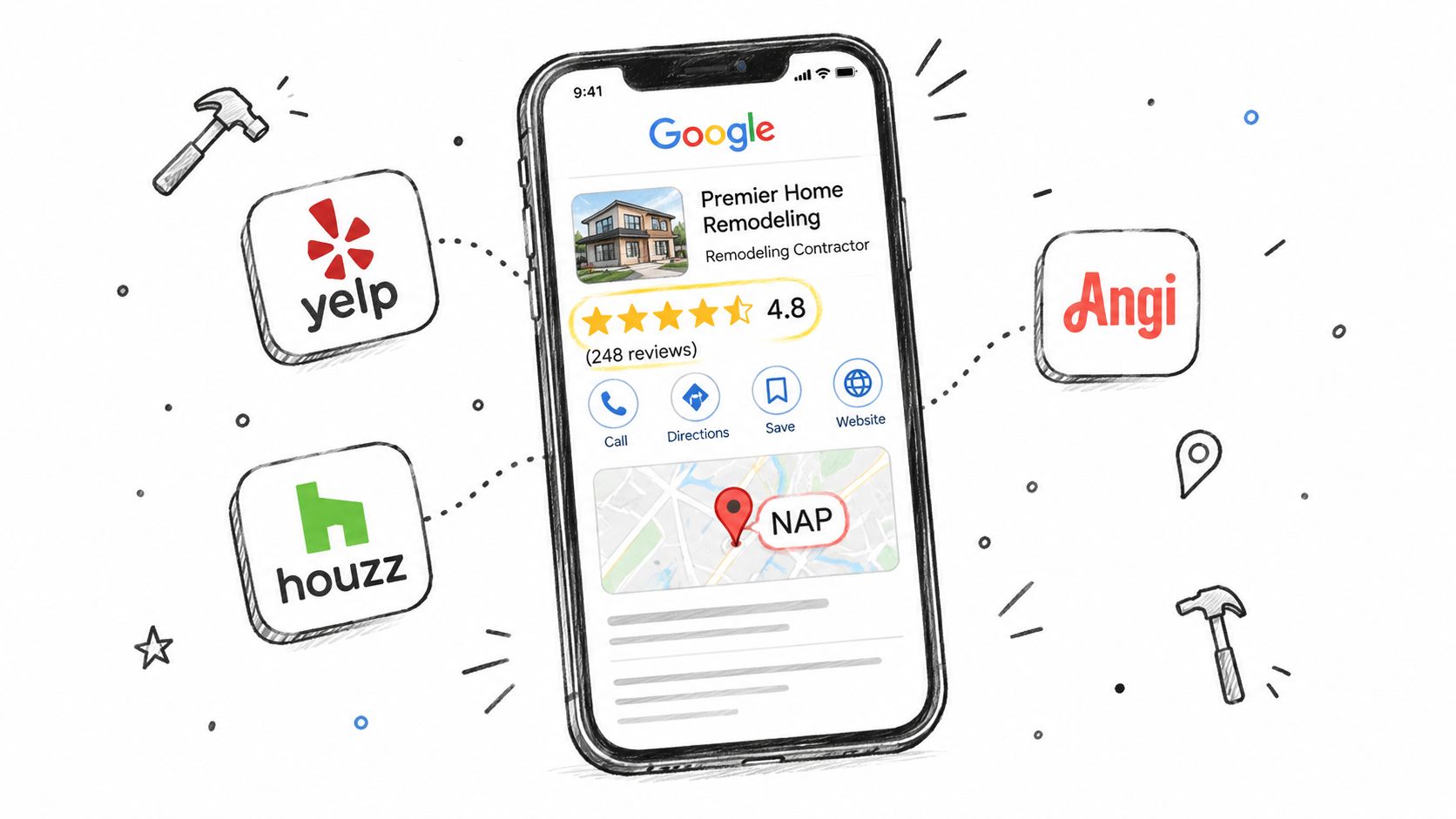
For most remodelers, Google Business Profile is the first thing a homeowner sees. It can show your phone number, categories, hours, reviews, photos, and services before anyone visits your site. A great website can't save a profile that looks abandoned or lists the wrong location.
Build the profile around real services
Start with the basics that must match everywhere. Check your name, address, and phone number on directories, chamber listings, trade groups, social profiles, and contractor sites. Fix any mismatches. Don't create duplicate listings.
Pick the most accurate primary category, such as General Contractor or Kitchen Remodeler. Then add only the secondary categories that truly fit. Set your service area by the towns you actually serve. A huge radius just brings in leads you can't take. List every real service, such as kitchen and bath remodeling, additions, basement finishing, or whole-home remodels.
Post project proof every week
Your profile needs fresh photos, not a gallery you uploaded years ago. Add finished rooms, work in progress, material close-ups, team photos, and outside shots. Show the kind of work you want more of. A kitchen remodeler should lead with kitchens, not truck photos.
Use weekly profile posts to rotate through these:
- Project updates. Explain the problem, the scope, and the result.
- Before and after shots. Shoot both from the same angle so the change is easy to see.
- Useful offers. Promote design consults or open dates. Not every post needs a discount.
Treat reviews the same way. Reply to each one within a day. If the reviewer named the project or the area, mention it in your reply. "Thanks for trusting us with your kitchen remodel in Oak Park" sounds more real than a stock line any contractor could post.
Back up the profile on your website. Build a page for each service area, with real project write-ups and local trust signals. Add LocalBusiness schema to your pages. The GeneralContractor type fits most remodelers. Embed a map where it helps.
Then pick three priority ZIP codes. Work toward a top-three Map Pack spot there before you expand. Strong reach where you can work at a profit beats thin reach across a whole region.
Paid Search and Landing Pages That Convert
Paid search can fill the gap while your local rankings grow. But it punishes loose targeting. Broad terms like "home improvement" attract researchers, unrelated services, and price shoppers. Start with high-intent local phrases tied to one service. Good examples are "kitchen remodel near me," "bathroom remodeling [city]," and "basement finishing cost [city]."
Benchmarks help you set targets. LocaliQ studied 3,211 U.S. search campaigns from April 2024 to March 2025. The typical home services campaign had a 6.37% click-through rate and a 7.33% conversion rate. It paid about $90.92 per lead. General construction and contractor campaigns converted at just 2.61%, at about $165.67 per lead. You can see the full numbers in LocaliQ's home services benchmarks.
Your market will differ. But if you're far below these numbers, fix the landing page before you blame the channel.
Match every click to one page
Build a separate landing page for each main service. A kitchen ad should open on a kitchen page. It should have kitchen photos, kitchen reviews, and a kitchen form. Give the page one main action, such as "Book a Design Consult" or "Request an Estimate."
Put trust signals near the top of the page:
- Local proof. Show recent project photos from the same city or a nearby area.
- Less risk. List your license and insurance where they apply.
- Reviews. Add reviews that describe the same service.
- Clear next steps. Explain what happens after someone sends the form.
Test your ads around three angles: clear pricing, a reliable timeline, and proof of good work. Don't swap headlines at random. Give each angle enough traffic to learn what homeowners care about most. It might be budget, schedule, or quality.
Use benchmarks as targets, not promises
Remodeling sales take time, so tracking matters. Send calls and form fills into one CRM record. Merge duplicates. Tag each lead with the service and ZIP code. Then record whether it became an estimate and a signed contract. That's how you learn your real close rate for each channel.
| Service line | How to start | Cost per lead | Conversion target |
|---|---|---|---|
| Kitchen and bath remodeling | Start with a small, controlled local budget. | Compare it to the $90.92 home services median. | Use the 7.33% home services median as a first target. |
| Additions and whole-home remodeling | Raise the budget only after lead quality is proven. | Expect it to run higher, closer to the $165.67 contractor median. | Judge it by booked estimates and signed work, not form fills. |
The biggest gains often come after the click. The 2007 Lead Response Management Study was run by researcher James Oldroyd with InsideSales.com. It found the odds of qualifying a lead were 21 times higher when a rep called within 5 minutes instead of 30. Treat that response time as part of your ad campaign. It isn't a separate office task.
Social Media and Listening for Real Local Demand
A boosted Facebook post can drive likes without driving jobs. Likes, views, and comments matter only when they help a homeowner trust your work. They should lead to a real question, or a call while the project is on their mind. Spend your next spare hour on the channel most likely to show a real local need.
Short-form video is worth a test. Film two or three project walkthroughs each week on your phone. Keep the story simple. Show what the homeowner wanted, what your team changed, and what the new space does better. Keep captions local and specific. "Basement finish in North Hills, with a home office and a storage wall" tells nearby viewers far more than "Another beautiful transformation."
Compare channels by buying signal
Instagram Reels and TikTok are good for visual proof and discovery. Nextdoor shows what neighbors recommend and complain about. Reddit threads often show early planning questions. Instagram comments can signal that someone is moving from ideas to a real project.
Boosted posts work best when the post already gets engagement from local people. They also work when the post shows a project people recognize. They fall flat when you're buying attention without a clear audience, offer, or follow-up plan.
Spend your next hour finding intent, not chasing reach.
Build a listening routine you can keep
Set up a routine your team can actually maintain:
- Nextdoor. Search a few times a week for words like "remodeler," "kitchen," "bathroom," "addition," and "contractor." Add local neighborhood names too.
- Facebook groups. Join local community and buy-and-sell groups. Check them for posts asking for contractors.
- Reddit. Watch local subreddits for project questions, contractor picks, and quote requests.
- Instagram. Follow local hashtags, neighborhood tags, designers, real estate agents, and suppliers.
- Comments and messages. Treat questions about availability, timelines, and rough scope as sales leads.
When someone asks for a recommendation, reply with helpful context, not a hard pitch. Mention the service you offer, the area you cover, and a similar project. Move to a private message only after your public reply shows you're a good fit.
Checking every group by hand gets old fast. Social listening tools can scan public posts for you. They filter posts by location and intent, drop duplicates, and send an alert with a link to the post. This guide to social media listening platforms compares the main options for local service businesses.

Speed to Lead and Follow-Up Workflows
Marketing creates the chance. Your response process decides whether you keep it. Every web form, profile call, social message, and community lead should land in the same system right away. It should carry enough detail for the right person to act.
Here's a workflow that works:
- Capture right away. Send every form, call, and message into your CRM, along with its source.
- Confirm within a minute. Send a text that confirms you got the request and says when a person will call. Add a checkbox to your form that asks permission to text.
- Call within 5 minutes. During business hours, a person should call, learn the project type, and confirm the home is in your area.
- Cover after hours. Route leads to an answering service, an on-call estimator, or a trained intake person. Don't make tomorrow the first contact.
- Merge duplicates. The same homeowner may reach you through search, your profile, and social media. Merge the records before anyone sends repeat texts.
- Tag for routing. Tag each lead by service, ZIP code, project stage, and timing.
Most businesses are slow, which gives fast contractors an edge. A Harvard Business Review study tested 2,241 U.S. companies with a web lead. Only 37% replied within an hour, and 23% never replied at all. Among firms that did reply within 30 days, the average wait was 42 hours. Firms that reached out within an hour were nearly seven times as likely to qualify the lead as firms that waited even one hour longer. Run intake like an emergency dispatch desk, and you'll beat most rivals to the call.
Qualify without interrogating
The first call should check fit. It shouldn't force an early price. Ask what the homeowner wants to change and what prompted the project. Ask where the home is, whether they have plans, and when they want to start. Confirm the job fits your scope and service area before you book an in-home estimate.
Write a short handoff note. Include the goal, the rooms, the address, the timing, who makes the decision, and any budget range they shared. The estimator should read it before arriving. That way, the homeowner doesn't have to tell the whole story twice.
A CRM doesn't replace judgment. It keeps good judgment from showing up too late. This roundup of contractor marketing tools compares options for intake, tracking, and follow-up. But the standard matters more than the brand. Every lead needs an owner, a timestamp, a next step, and a recorded outcome.
Referrals, Reviews, and On-Site Proof
Finished projects should keep marketing for you after the crew leaves. A happy client can give you a review, a referral, photo rights, an intro to a neighbor, or a yard sign spot. Most contractors lose that value because nobody owns the follow-up.
Build these asks into your closeout process. Do a final walkthrough soon after the job ends, while it's fresh, and fix any open issues. Then send every client a direct link to your Google review page. Ask them to describe the actual work. Later, ask whether anyone nearby is planning similar work, and make it easy for them to introduce you.
A simple sequence looks like this:
- At completion. Do a final walkthrough and fix any open issues.
- Review request. Send every client a direct link with a personal note.
- Referral ask. Explain which project types and areas you serve.
- Photo approval. Sort before-and-after shots so the homeowner can share them easily.
Be careful with rewards. A referral credit can work if you write down the terms and follow local rules. Reviews are different. Google's review policy bans offering anything in return for a review. It also bans asking only happy clients for reviews. So ask everyone, and let the reviews reflect the real experience.
Turn the job site into local media
Put up a clean, readable sign where the homeowner allows it. Include your company name, the service, a phone number, and a link or QR code you can track. Keep the site tidy for the whole project. A messy site undercuts the very proof the sign is meant to create.
Ask permission to photograph matching before-and-after angles, close-ups of the work, and the finished space. Note the city or neighborhood so you can reuse the photos in the right place. One project can feed your map listing, landing pages, social video, review replies, and referral asks.
Track it all in one sheet or CRM. Record the lead source, project type, neighborhood, estimate date, and close status. Add whether you asked for a review, got a review, got a referral, and have photo permission. Over time, that record shows where the profit came from. It might be the paid click. It might be the review and referral that followed.
Your 90-Day Remodeling Marketing Plan
A small remodeling company doesn't need twenty separate tactics. Good marketing for remodeling contractors is a sequence where each step makes the next one work better.
Weeks 1 and 2
Claim and complete your Google Business Profile. Check your categories, services, service areas, hours, photos, phone routing, and review link. Install call tracking and set up review requests. Clean up your business details on the main directories.
Checkpoint: Can a homeowner find the right number, see recent work, understand your services, and ask for help without guessing?
Weeks 3 and 4
Create service-area pages for the cities that bring in profitable work. Add project pages for your core services. Include local proof, real photos, process details, and a clear call to action. Build one landing page for each main paid service.
Checkpoint: Does every key ad and local search land on a page that matches the exact project the homeowner wants?
Weeks 5 and 6
Launch a Google Ads test around three high-intent keyword themes. Target only your service area. Use call and form tracking, negative keywords, dedicated landing pages, and CRM routing. Set a 5-minute response goal and review search terms often.
Checkpoint: Are you tracking qualified leads, booked estimates, and results by source, not just clicks?
Weeks 7 and 8
Post short project walkthroughs two or three times a week. Start regular searches on Nextdoor, Reddit, Facebook groups, and Instagram for local project language. Add the referral ask to your estimate handoff and closeout process.
Checkpoint: Are you finding conversations before competitors do? Does every social lead get an owner and a next step?
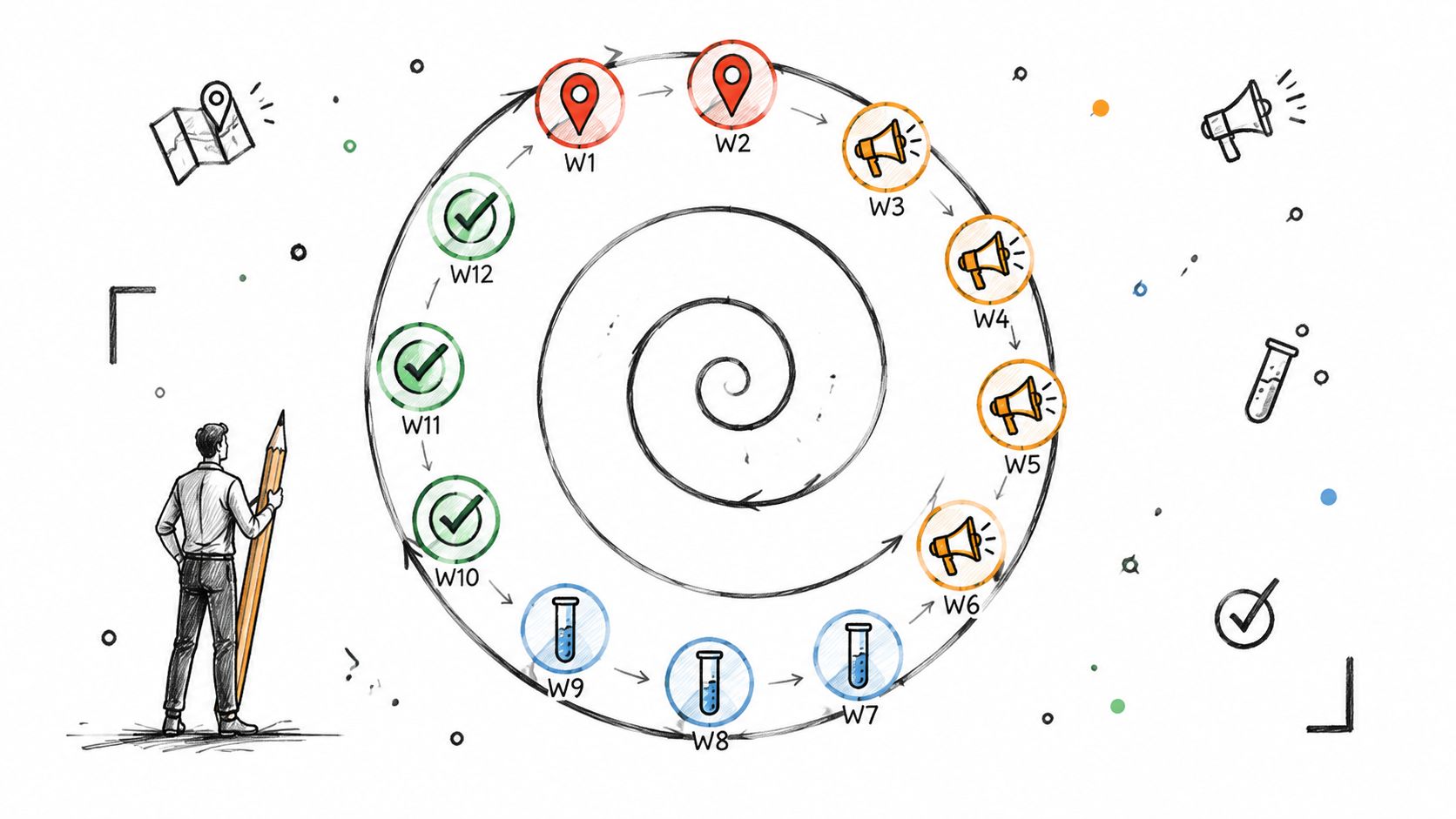
Weeks 9 and 10
Add new channels only after your tracking and landing pages work. Consider Google Local Services Ads if your trade qualifies in your area. Meta retargeting on a tight budget is another option. Don't add a channel to hide weak follow-up. Check your review replies, recent photos, and whether your profile is complete.
Checkpoint: Are new channels booking qualified appointments, or just adding noise to your reports?
Weeks 11 and 12
Review cost per lead, response time, booking rate, estimate rate, close rate, and project fit. Cut campaigns that bring poor leads or that you can't answer quickly. Put more into the sources that bring work your team can deliver at a profit.
Checkpoint: Can you name the channel behind each signed project? Can you say what happened after the first contact?
Marketing for remodeling contractors gets easier when someone owns every stage of the pipeline. Start this week. Fix your profile, install source tracking, and test your own response time with a real lead.
Want to find remodeling leads on social media without checking every group yourself? ThroughTheGrapevine.ai watches public posts for people near you who are asking for a remodeler. It covers the Facebook groups you choose, plus Reddit, X, Threads, Bluesky, and LinkedIn. Each match is tagged with a location and scored for buying intent. It then lands in your inbox with a link to the post and a suggested reply. Start a free 7-day trial. No credit card is needed.